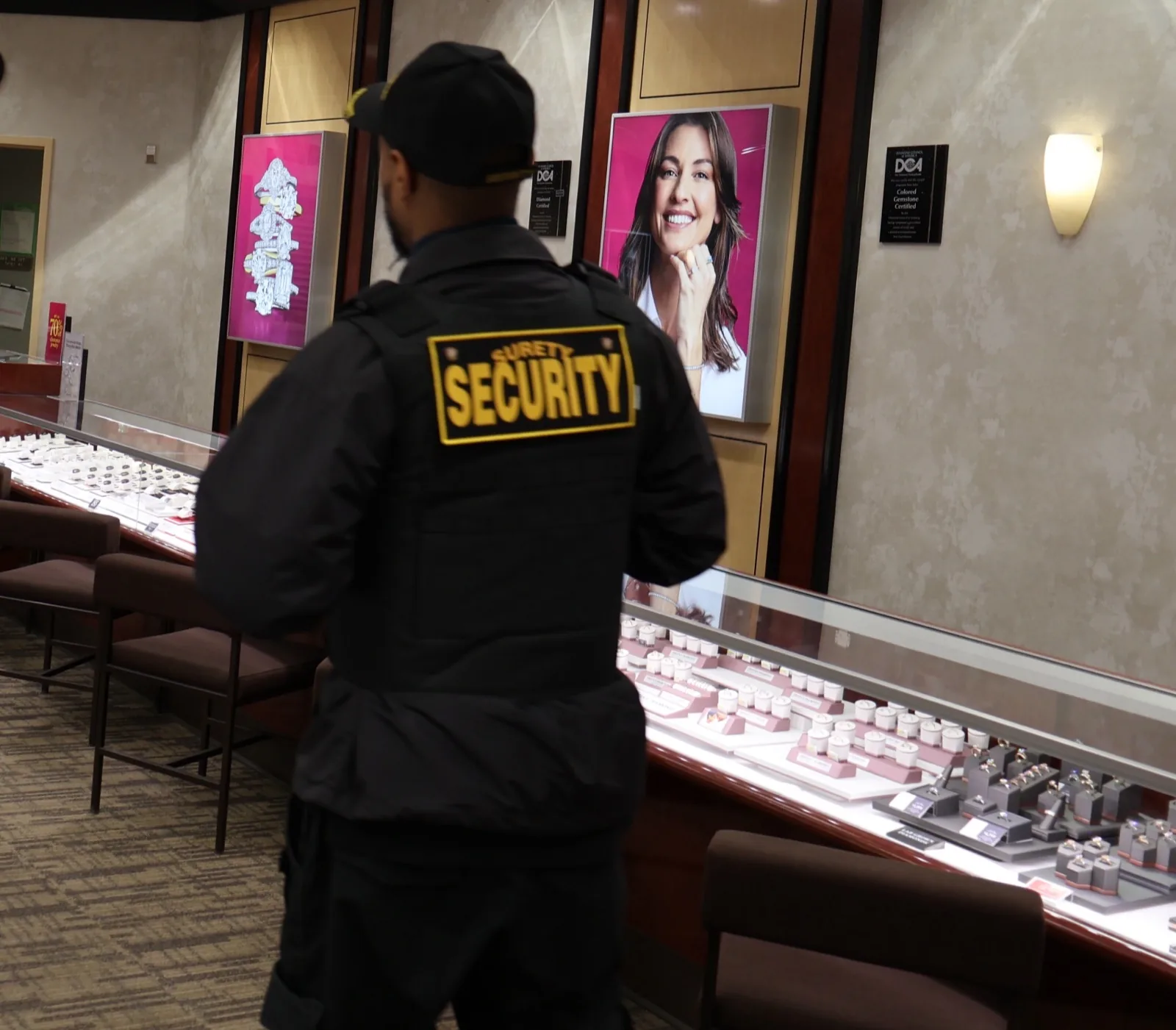
JEWELRY STORE SECURITY: WHY ARMED GUARDS MATTER
Why jewelry retailers in Washington State are choosing armed security, what it costs, and how to structure a security program that protects your people, inventory, and business.

Jewelry stores operate in a threat environment that is fundamentally different from most retail businesses. The combination of high-value, easily concealed merchandise, predictable business hours, and public-facing operations creates a risk profile that demands specialized guard service measures. In Washington State, armed protection services is increasingly becoming a standard component of jewelry store protection.
This guide examines why armed protection matters for jewelry retailers in Washington, what to look for in an armed guarding provider, and how to structure a protective services program that protects your people, your inventory, and your business.
THE THREAT LANDSCAPE FOR JEWELRY RETAILERS
Jewelry store robberies are among the most dangerous retail crimes. Unlike shoplifting or organized retail theft, jewelry store robberies often involve armed suspects, physical violence, and the potential for hostage situations. The FBI and Jewelers' This Alliance track these incidents nationally, and the data is sobering:
- Jewelry stores experience disproportionately high rates of armed robbery compared to other retail categories
- Smash-and-grab burglaries targeting display cases have increased significantly in Washington State and across the Pacific Northwest
- Employee safety is at elevated risk during opening and closing procedures when staffing is minimal
- The resale value and portability of jewelry makes it an attractive target for both opportunistic and organized criminal activity
Washington State has seen a notable increase in retail crime including organized theft rings targeting high-value merchandise. Jewelry stores in shopping centers, standalone locations, and downtown retail corridors all face varying degrees of this risk.
WHY ARMED GUARDS MATTER FOR JEWELRY STORES
The decision to deploy armed security at a jewelry store is driven by the nature of the threat. Unarmed guard service provides visible deterrence and can be effective for managing customer flow, monitoring suspicious behavior, and handling non-violent incidents. But when the threat profile includes armed robbery, the calculus changes.
Deterrence That Matches the Threat
The visible presence of a uniformed, armed security officer at a jewelry store entrance sends an unambiguous signal to potential offenders. Research consistently shows that armed protection services presence is the single most effective deterrent against armed robbery in high-value retail environments. Criminals conducting pre-operation surveillance routinely select targets without visible armed protection over those with it.
Response Capability
In the event of an attempted robbery, an armed security officer has response options that unarmed personnel do not. This does not mean that armed officers are expected to engage in gunfights. Professional armed guarding training emphasizes de-escalation, tactical positioning, employee and customer safety, and communication with law enforcement. The armed officer's presence changes the dynamics of an incident before it escalates.
Insurance and Compliance Considerations
Many jewelry store insurance policies either require or provide premium discounts for armed protective services presence during business hours. Jewelers Mutual and other specialty insurers that serve the jewelry industry frequently specify this requirements that include armed guard coverage. Verify your policy's security requirements and discuss them with your insurance carrier.
Armed security for jewelry stores in Washington is provided through PROSTASIA Security, SURETY Security's armed division. All armed officers are individually licensed through the Washington State Department of Licensing and undergo firearms qualification and de-escalation training.
STRUCTURING A JEWELRY STORE SECURITY PROGRAM
Effective jewelry store security is not just about posting an armed officer at the door. A comprehensive security program includes multiple layers:
Armed Officer Placement and Procedures
Armed officers should be positioned at the primary customer entrance with clear sightlines to display cases and the sales floor. Post orders should include specific procedures for greeting and screening customers, monitoring for pre-robbery surveillance behavior, and coordinating with law enforcement during incidents.
Opening and Closing Protocols
The highest-risk periods for jewelry store robberies are opening and closing. Armed security should be present during these transitions, with specific procedures for securing merchandise before store closing and verifying perimeter security before opening.
Special Event and High-Value Display Coverage
Trunk shows, holiday seasons, and special promotional events increase both foot traffic and the value of merchandise on display. These periods may warrant additional armed security staffing beyond your standard daily coverage.
Technology Integration
Armed security works best as part of an integrated approach that includes camera systems, buzzer entry systems, reinforced display cases, and alarm systems. The armed officer provides the human judgment and response capability that technology alone cannot deliver.
ARMED SECURITY COSTS FOR JEWELRY STORES
Armed security for jewelry stores in Washington State typically runs $34 to $50 per hour depending on the specific requirements:
- Standard business hours coverage (single officer): $34 to $44 per hour
- Extended hours or weekend coverage: $38 to $48 per hour
- Special event or holiday coverage: $42 to $50 per hour
- Opening and closing escort only: Typically structured as 2 to 4 hour daily minimums at standard armed rates
For a jewelry store open 10 hours per day, 6 days per week, armed security coverage represents a monthly investment of approximately $8,800 to $11,440 at current market rates. Many jewelry store owners find this investment reasonable when weighed against the potential loss from a single robbery event and the insurance benefits of maintaining armed coverage.
CHOOSING THE RIGHT ARMED SECURITY PROVIDER
When selecting an armed security company for your jewelry store, prioritize these factors:
- Verified licensing: Every armed officer assigned to your store should hold a current Washington State armed security guard license. Ask for license numbers and verify with the Department of Licensing.
- Jewelry retail experience: Armed security in a jewelry environment requires specific training in customer interaction, robbery response, and merchandise protection. General armed security experience does not automatically translate.
- Professional appearance and demeanor: Your armed officer is a visible representative of your business. Professional appearance, courteous customer interaction, and appropriate demeanor are non-negotiable.
- Consistency of personnel: Frequent officer rotation undermines the deterrent value of armed security and prevents officers from learning your store's specific patterns and vulnerabilities. Demand personnel consistency.
- Incident reporting: Require digital incident reports for every shift, documenting any suspicious activity, customer interactions of concern, and security observations.
THE BOTTOM LINE
Jewelry stores face a threat profile that warrants armed security. The investment in professional armed officers protects your employees, your customers, and your inventory while satisfying insurance requirements and providing a visible deterrent against the most serious retail crimes. In Washington State, the cost of armed jewelry store security ranges from $34 to $50 per hour, a fraction of the potential loss from a single successful robbery.
If you operate a jewelry store in Washington State and want to evaluate your security options, Contact Us for a free security assessment. We serve jewelry retailers through our armed division, PROSTASIA Security.
We visit your property, assess your needs, and deliver a written security plan and pricing within 24 hours.
MORE FROM SURETY SECURITY